Anglera: AI Search Visibility Audit and 90-Day Growth Roadmap
A public-data AEO, SEO, CRO and competitive audit mapping how a YC-backed product with Stanford and Uber Eats founders can claim an unclaimed AI search category.
Methodology & Data Sources
This audit is based entirely on publicly available data: the live anglera.com site, Google index status ("site:anglera.com"), YC directory listing, LinkedIn profiles, and direct testing of 12 AI search queries across two engines — ChatGPT and Perplexity — conducted April 12–15, 2026.
Scope: 12 queries × 2 engines = 24 individual tests. Anglera appeared in 0 of 24 tests. Claude, Gemini, and Google AI Overviews were not tested in this audit; expanding to those engines is part of a full engagement.
A key limitation: anglera.com uses client-side JavaScript rendering (CSR), which means external crawlers — including ours — see a mostly empty HTML shell. This audit reflects what search engines and AI bots see, not what a logged-in user sees. Some content and features may exist behind the JS layer that we couldn't evaluate.
AI model outputs can vary between sessions and change as models are updated. This is a point-in-time snapshot.
Target ranges are informed by benchmarks from similar B2B SaaS companies (seed to Series A stage, 20–80 employees) that executed content-first growth strategies, as documented in public SEO case studies (e.g., Animalz, Foundation Inc., Grow & Convert, HubSpot research). These are achievable ranges, not guarantees — actual results depend on execution speed, content quality, and competitive dynamics.
AEO Queries Tested (12)
Each query was manually tested across ChatGPT and Perplexity.
| Query | Cited? | Platform | Cited instead |
|---|---|---|---|
| “best AI tool to enrich product data for e-commerce” | No | — | Hypotenuse AI, Akeneo, Describely |
| “automate product catalog data entry” | No | — | Salsify, Akeneo, Plytix |
| “Salsify alternative for small e-commerce” | No | — | Akeneo, Plytix, Catsy |
| “AI product data enrichment tool” | No | — | Hypotenuse AI, Salsify |
| “how to automate product descriptions for marketplace” | No | — | Hypotenuse AI, Jasper, Copy.ai |
| “best PIM for Shopify sellers” | No | — | Plytix, Akeneo, Catsy |
| “AI-powered product catalog management” | No | — | Salsify, Akeneo, Feedonomics |
| “cheap alternative to Akeneo for startups” | No | — | Plytix, Ergonode |
| “automate product attribute extraction” | No | — | Salsify, Hypotenuse AI |
| “what is agentic commerce” | No | — | No specific product cited |
| “tools for AI-native product data” | No | — | Hypotenuse AI, Constructor |
| “product data enrichment API for e-commerce” | No | — | Salsify, Akeneo, Algolia |
AI model outputs vary between sessions and change as models update. This is a point-in-time snapshot.
Evidence
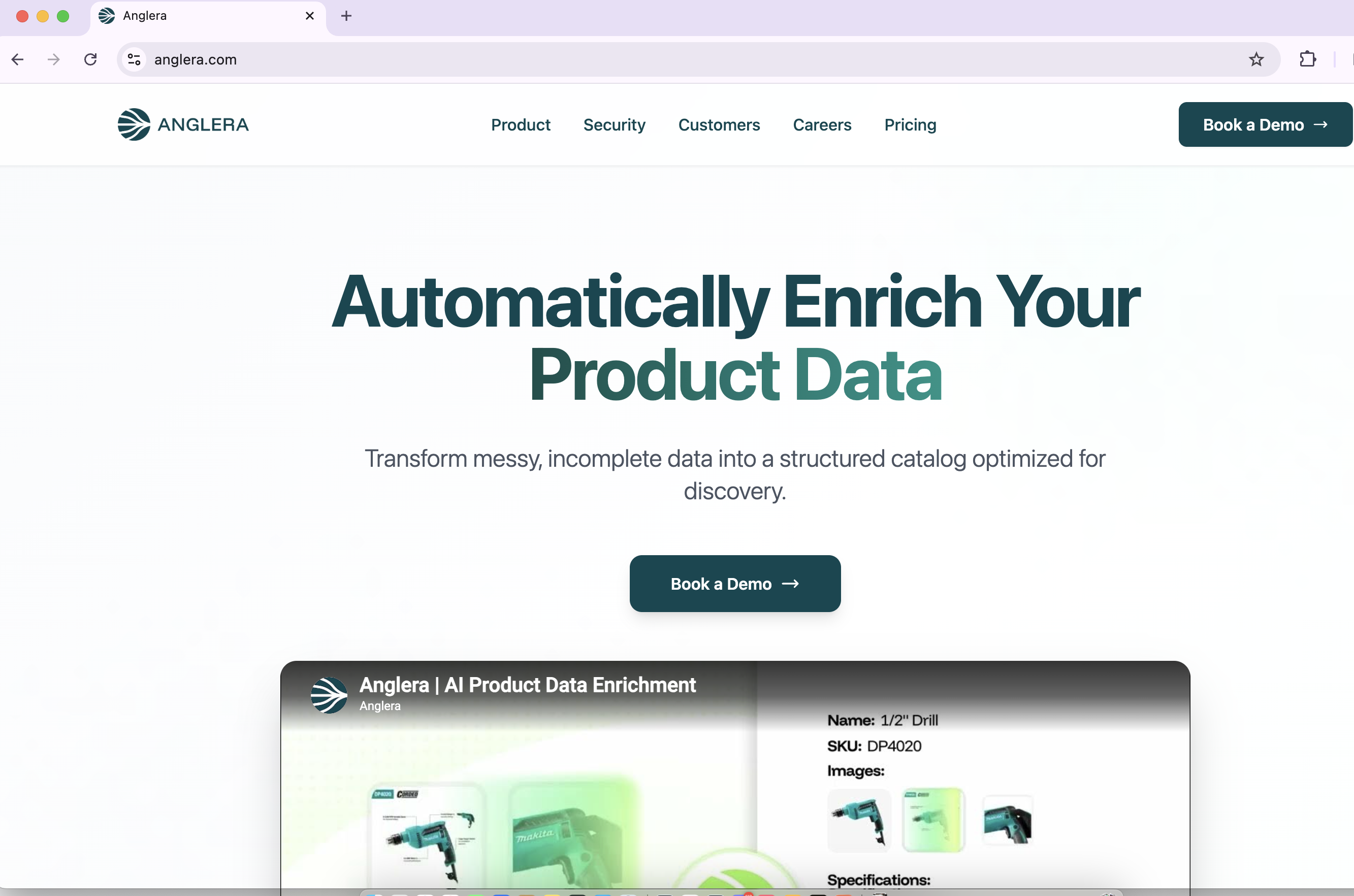
Anglera.com looks great to human visitors — clean design, clear value prop, Book a Demo CTA. The product experience is strong.
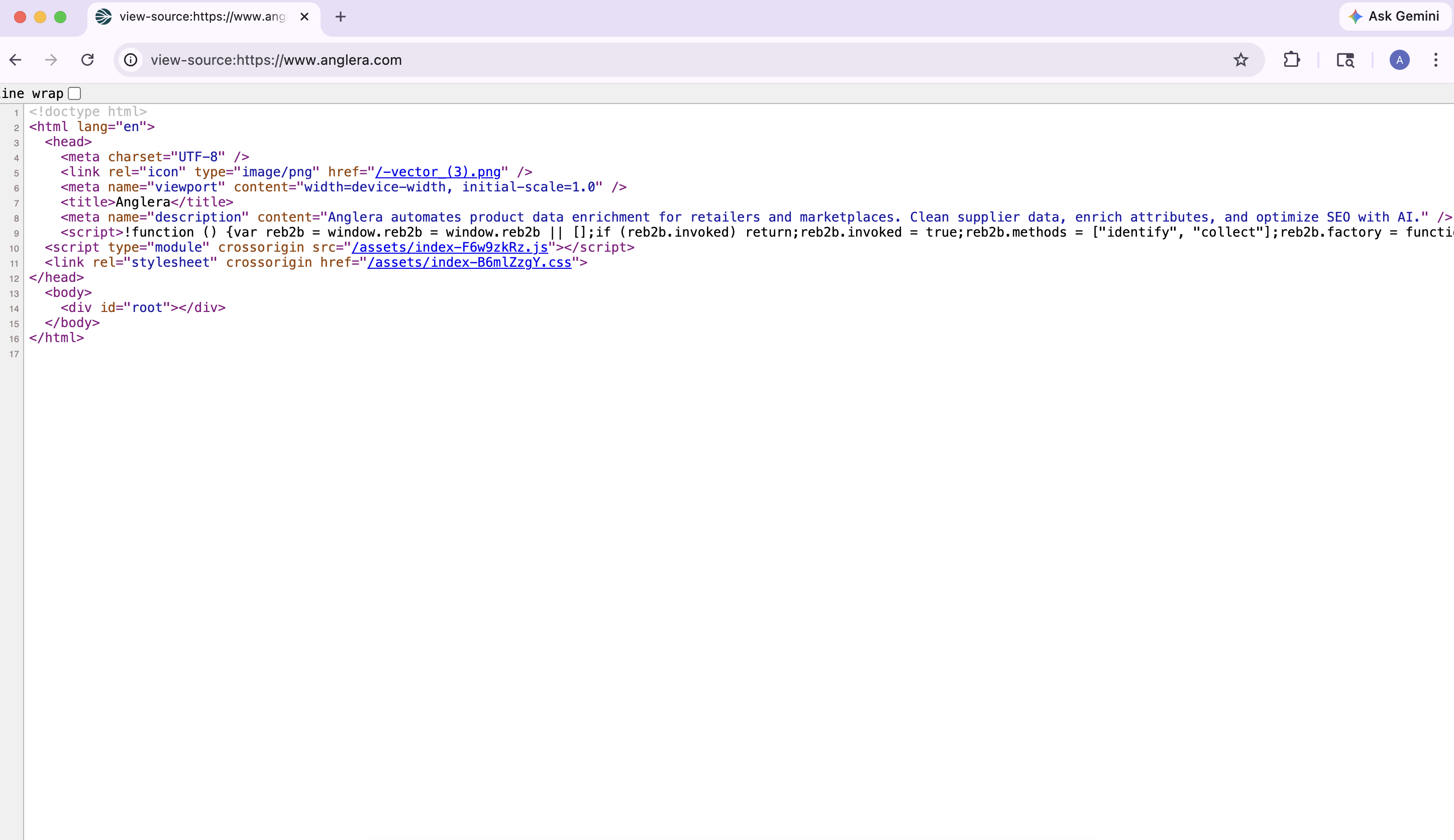
The same URL through view-source tells a different story. The entire page is a single <div id='root'> — all content loads via JavaScript. This is a common choice for product-focused teams, and the fix (SSR/SSG) is straightforward.
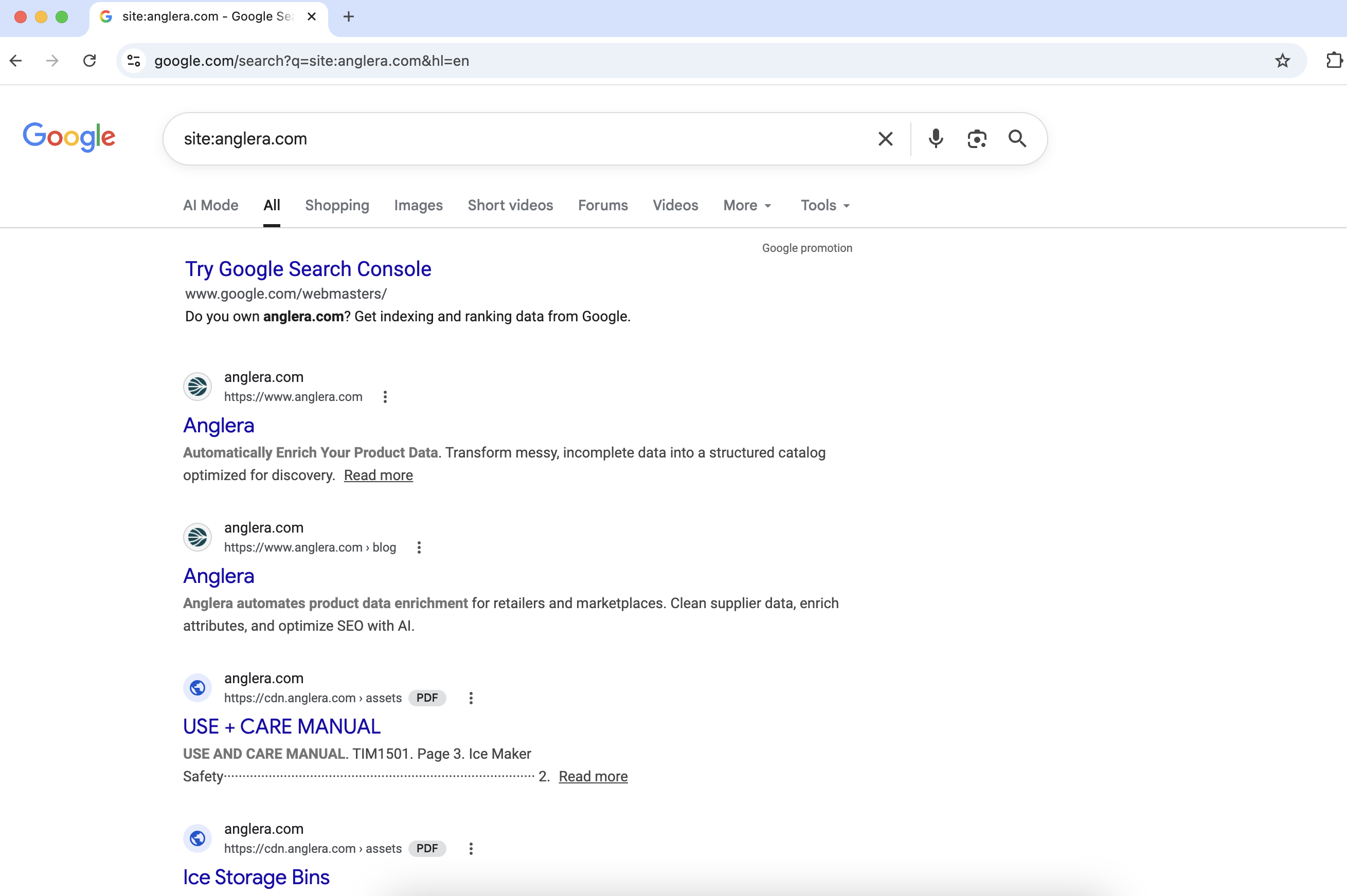
Google's index shows the homepage, a blog page, and miscellaneous PDF assets (product manuals) — but no strategic content pages, no comparison pages, no landing pages. Competitors have 300–500+ indexed pages driving organic traffic.
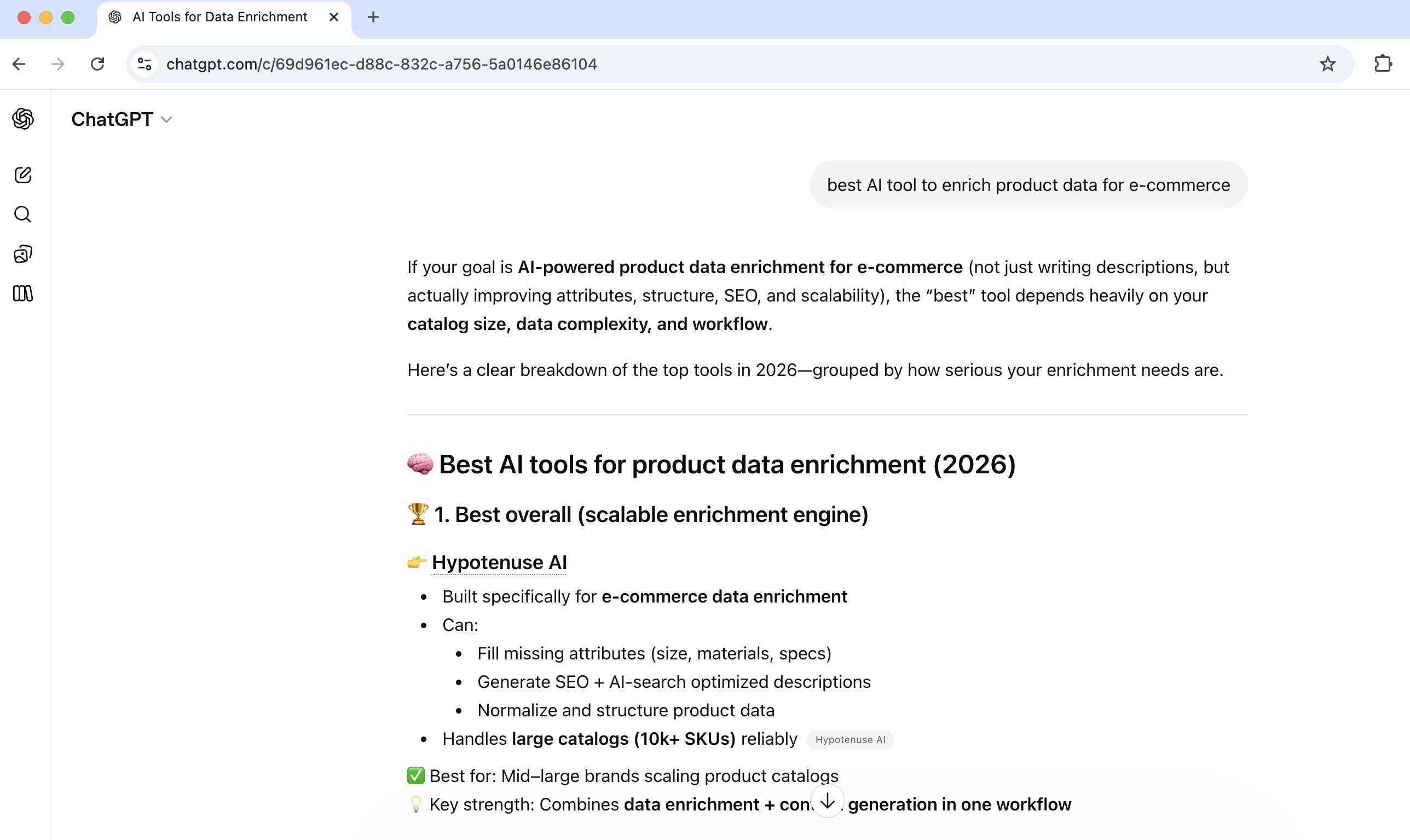
ChatGPT recommends Hypotenuse AI as the #1 tool for product data enrichment — a competitor with ~$10M funding. Anglera, with comparable category positioning and YC-validated traction, doesn't appear in the response.
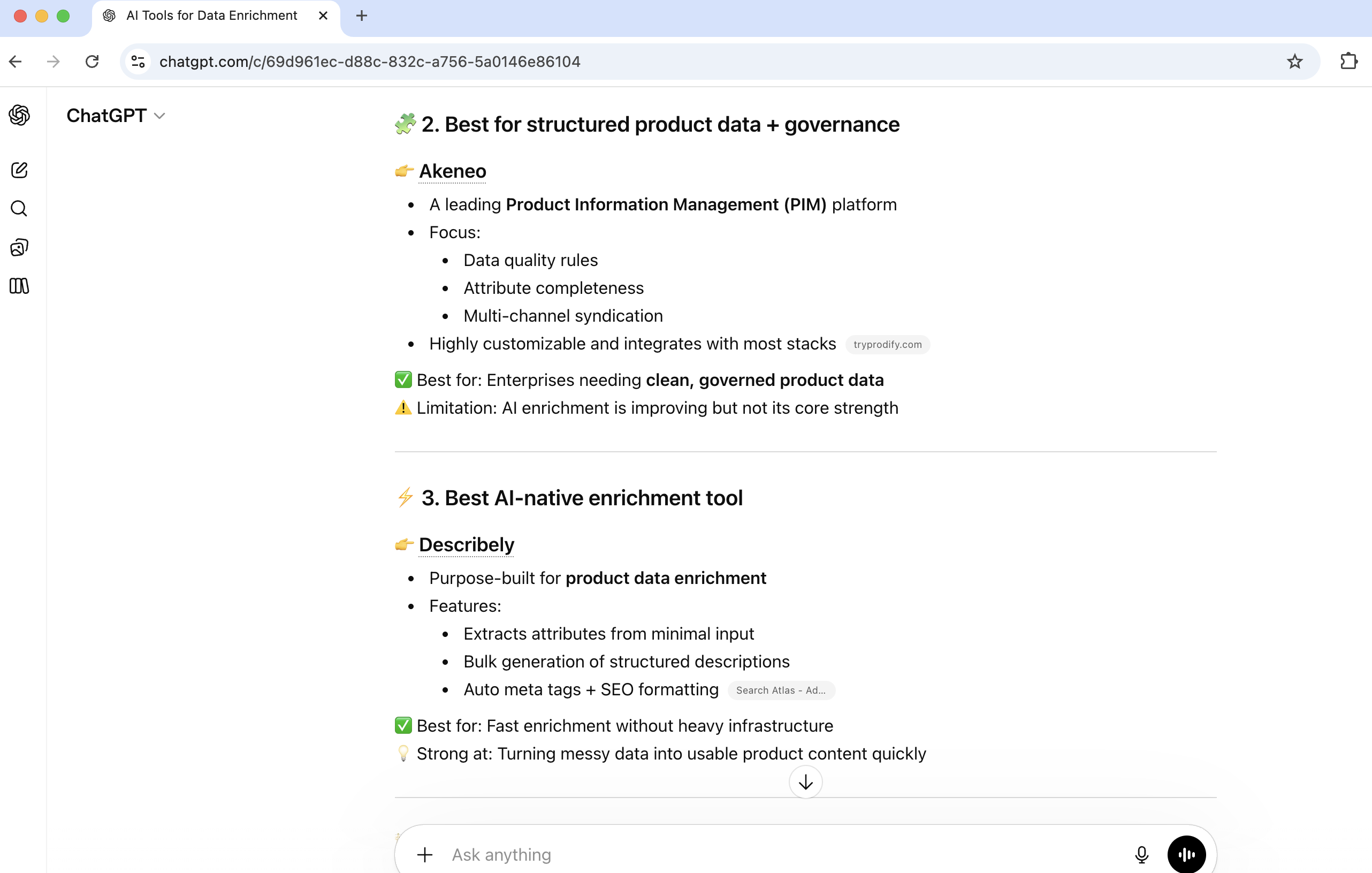
The full response lists Hypotenuse AI, Akeneo, and Describely. The AI-native product data category is wide open — and Anglera's unique positioning (YC-backed, Stanford founders, agentic commerce) hasn't been claimed by any of these players.
The Opportunity
Anglera is a YC-backed AI startup that automates product data enrichment for e-commerce — turning weeks of manual data entry into minutes. Founded by Stanford and Uber Eats alumni, the team has real paying customers (validated demand) and a working product.
The founders have been focused on building a great product — and it shows. The next stage is making that product visible to the buyers actively searching for exactly what Anglera offers.
Today, Anglera has 4 indexed pages and 0 citations across 24 AI search tests. The upside is significant: the category is growing fast, and none of the competitors have claimed the "AI-native product data for agentic commerce" positioning. The marketing engine needs to match the product.
AEO Strategy: AI Search Visibility
We tested 12 high-intent queries that Anglera's ideal customers ask AI assistants — from "best AI tool to enrich product data for e-commerce" to "Salsify alternative for small e-commerce." Across ChatGPT and Perplexity, competitors like Salsify, Akeneo, and Hypotenuse AI occupy every position. Anglera appears in none.
But none of the cited competitors own the AI-native narrative. They built for the human web — manual catalogs, traditional PIM workflows. Anglera is building for a future where AI agents browse and purchase products. That narrative is unclaimed.
The AEO playbook starts with structural fixes to make the site crawlable by AI bots (GPTBot, PerplexityBot, ClaudeBot), then rapidly builds the content that earns citations: comparison pages ("Anglera vs Salsify"), Reddit and HackerNews presence (which AI models heavily cite), structured FAQ content with schema markup, and category-defining articles that position Anglera at the center of "AI product data enrichment."
Tracking progress covers bi-weekly manual testing of the same 12 queries across ChatGPT, Perplexity, and Google AI Overviews, measuring citation rate over time. Referral traffic from AI sources (identifiable by referrer headers) is tracked in analytics. AEO measurement is still an emerging discipline — no standardized tools exist yet — so we use a repeatable manual protocol with documented methodology.
Entity Graph: Building Authority Signals
Anglera's entity footprint is nearly empty. No Wikidata entry, no Crunchbase profile beyond the YC directory listing, no structured LinkedIn company page, no Wikipedia mention. AI engines build entity associations from cross-referenced structured data — and right now, there is nothing to cross-reference.
This is the single largest gap in the audit. The founding team has strong authority signals — Stanford, Uber Eats, YC — but none of this is structured in a way AI crawlers can extract and cite. A Crunchbase profile with funding data, a LinkedIn company page with employee and founding details, and a Wikidata entry linking to the YC batch and Stanford affiliations would create the entity graph that AI engines use when deciding which products to recommend.
The technical implementation: add sameAs schema on anglera.com pointing to Crunchbase, LinkedIn, YC directory, and any press coverage. Ensure the Organization schema includes founders with their Person schema referencing Stanford and Uber Eats affiliations. This turns scattered facts into a connected entity graph that AI models can traverse.
Without this step, even strong content and technical foundation won't earn citations — AI engines recommend entities they can verify across multiple authoritative sources.
SEO Roadmap: From 4 Pages to 40–60
Anglera's current site uses client-side JavaScript rendering, which means search engines and AI crawlers can't access the content. This is a common pattern for product-focused teams who prioritized the app experience — and the fix is straightforward.
The first move is switching to server-side rendering (SSR) or static site generation (SSG). This one change unlocks everything that follows: proper indexing, AI crawler access, and the ability for content to compound over time.
From there, the content opportunity is significant. The product data enrichment category has clear buyer intent keywords that no one Anglera's size is targeting: comparison pages, use case pages (marketplace, D2C, multi-channel), and educational content about agentic commerce. A targeted program of 4 posts/month, combined with 5 comparison pages and 3 use case pages, creates a realistic path to 40–60 indexed pages in 60–90 days, based on typical indexing timelines for new SSR sites with proper technical setup.
The competitive gap works in Anglera's favor here — with low existing competition from companies at their stage, each new page has a clear path to ranking without fighting years of entrenched SEO.
CRO Blueprint: Converting Visitors into Demos
Once traffic starts flowing through AEO and SEO, the conversion architecture needs to capture it. The current site has a "Book a demo" CTA — a solid starting point.
The CRO playbook covers four moves. First, unify the homepage entry point and add a clear value prop above the fold with customer proof. Second, create multiple engagement paths — an interactive demo for the curious, a free trial for the hands-on, and a ROI calculator for the data-driven buyer. This ensures visitors at every stage of the funnel have a natural next step.
Third, amplify the existing social proof. Anglera already has paying customers — their stories, results, and use cases become the most powerful conversion tool when structured as detailed case studies with measurable outcomes.
Fourth, a dedicated pricing page with transparent tiers lets buyers self-qualify before they book a demo — reducing friction and increasing the quality of inbound leads. In a category where competitors show pricing openly, meeting that expectation builds trust.
Note: we couldn't evaluate the full conversion experience due to CSR rendering. A deeper CRO audit with access to the rendered site, analytics data, and conversion funnel metrics would refine these recommendations significantly.
Competitive Positioning: The Category Anglera Can Own
The product data enrichment and PIM space is large and growing. Salsify ($400M+ funding) and Akeneo ($90M+ funding) own the enterprise segment. Hypotenuse AI, closer to Anglera's stage, has built strong comparison content. The incumbents have scale — but they also have a blind spot.
Every established player built for the human web: manual catalogs, traditional PIM workflows, human-operated storefronts. Anglera is building for a fundamentally different future — one where AI agents browse, compare, and purchase products autonomously. This is the "agentic commerce" wave, and no one has claimed it yet.
The positioning: "Salsify and Akeneo were built for the human web. Anglera is building product data infrastructure for AI agents." This differentiator, backed by content that defines the "agentic commerce" category, gives Anglera an uncontested territory that no competitor — regardless of funding — can credibly claim.
This isn't about outspending the incumbents. It's about being first to own the narrative that defines where e-commerce is going next.
Competitive Landscape
| Company | Type | Funding | AI Search Presence | Content Pages |
|---|---|---|---|---|
| Salsify | Enterprise PIM | $400M+ | High | 500+ |
| Akeneo | Open Source PIM | $90M+ | Medium | 300+ |
| Hypotenuse AI | AI Content + Enrichment | ~$10M | Medium | 80+ |
| Outfindo | AI Data Enrichment | Seed | Low | ~20 |
| Feedonomics | Feed Management | Acquired | Medium | 200+ |
| Zoovu | Catalog + Discovery | $30M+ | Low | 100+ |
| Constructor | AI Product Discovery | $100M+ | Medium | 150+ |
| Anglera | AI Product Data Enrichment | YC (Seed) | None | 4 |
Prioritized Recommendations
Step 1 — AI Visibility Audit & Baseline
Step 2 — Technical Foundation & Agent-Readiness
Step 3 — Entity Graph & Profiles
Step 4 — Citation-Worthy Content
Step 5 — Community & Citation Sources
Step 6 — Prompt Testing & Feedback Loop
What We'd Need to Go Deeper
This audit is based on publicly available data and has inherent limitations. To build a fully actionable growth plan, we would need access to: current website analytics (traffic sources, bounce rates, conversion funnels), the rendered site experience behind the JS layer, Google Search Console data (impressions, clicks, crawl stats), customer acquisition cost and pipeline data, and any existing keyword research or content strategy documents. These gaps are standard for a public-data audit — and closing them is the natural first step of an engagement.
Conclusion
Anglera has a strong positioning opportunity in e-commerce SaaS. The product works, YC validated the vision, real customers are paying — and the "AI-native product data for agentic commerce" category is open.
The six-step roadmap follows itscool.ai's methodology: baseline the visibility gap, fix the technical foundation, build the entity graph, create citation-worthy content, establish third-party citation sources, and run a continuous prompt testing loop. The technical fixes are straightforward, the content opportunities target high-intent queries with low competition, and the category positioning is differentiated.
A strong product with a clear path from undiscoverable to well-positioned — through structured AEO, SEO, and conversion optimization.
The first step is a 15-minute walkthrough of these findings — and a look at what the rendered site reveals that public data can't.
Want an audit like this for your startup?
We run free AEO + SEO + CRO audits for qualified SaaS startups. No strings attached — just actionable insights you can use today.